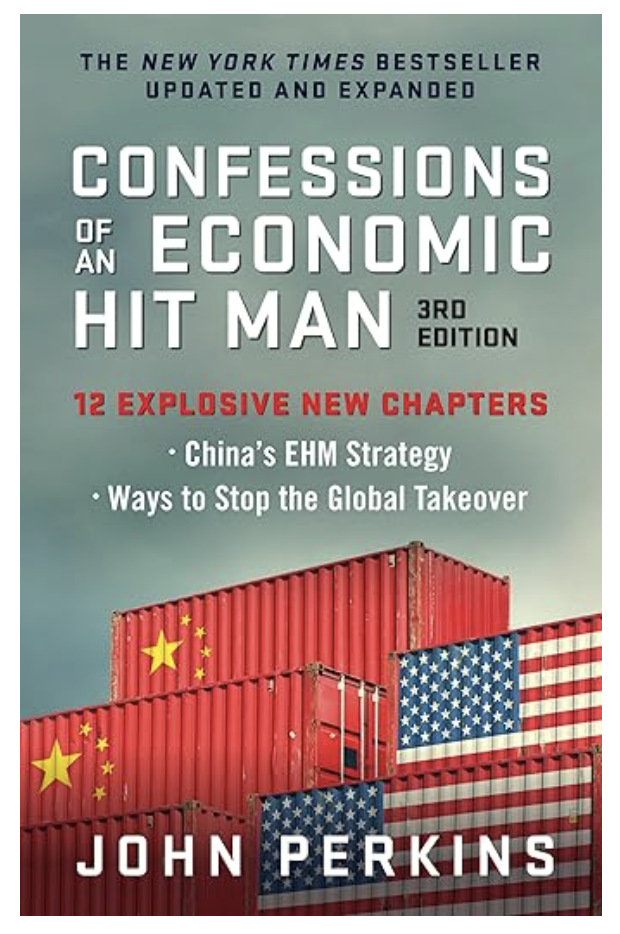
Here is a chronological documentation of the scope and reach of the Economic Hit Man (EHM) system in the years since Confessions of an Economic Hit Man was first published. Among the following items are reports by nonprofit organizations and government bodies, leaked documents and other confidential materials, journalistic investigations, and more. Some items focus on a single, specific instance of EHM activity; others document systematic actions by a variety of entities over long periods. This list is not meant to be comprehensive but rather to illustrate the extent to which the EHM system infiltrates every aspect of our global economy.
I either have quoted directly from articles and reports or have summarized and paraphrased their content, and I have identified key points in boldface. I have not attempted to verify the information provided or the conclusions reached by these sources. Thus, the analyses, opinions, and conclusions presented below are those of the authors, publications, and websites referenced, not my own. I leave it to you to arrive at your own conclusions.
– John Perkins
2004
A United Nations study argues that tied aid is “strangling” nations, as reported by the Inter Press Service news agency: “Donor money that comes with strings attached cuts the value of aid to recipient countries 25–40 percent, because it obliges them to purchase uncompetitively priced imports from the richer nations, says a new UN study on African economies. . . . ‘The United States makes sure that 80 cents in every aid dollar is returned to the home country,’ says Njoki Njoroge Njehu, director of 50 Years is Enough, a coalition of over 200 grassroots nongovernmental organizations.”
www.ipsnews.net/2004/07/development-tied-aid-strangling-nations-says-un
Rights and Accountability in Development (RAID) releases a report that follows up on an earlier series of United Nations reports that documented “the links between business, resource exploitation, and conflict” in the Democratic Republic of the Congo. The RAID report, titled Unanswered Questions: Companies, Conflict and the Democratic Republic of the Congo, includes a section examining the banking sector, which cites (among other infractions) the United Nations allegation that “MIBA [Societé Minière de Bakwanga, the state-owned diamond mining company] accounts held by Belgolaise Bank have been used to conduct financial transactions involving the purchase of armaments by the Government of the DRC.”
www.raid-uk.org/sites/default/files/unanswered-qq.pdf
United Nations report:
daccess-dds-ny.un.org/doc/UNDOC/GEN/N03/567/36/IMG/N0356736.pdf
United Nations press release on the report:
www.un.org/apps/news/story.asp?NewsID=8706
Global Justice Now (formerly the World Development Movement) releases a report titled Zambia: Condemned to Debt — How the IMF and World Bank Have Undermined Development. The report “clearly demonstrates that the IMF and World Bank’s involvement
in Zambia has been unsuccessful, undemocratic, and unfair. The evidence suggests that the past twenty years of IMF and World Bank intervention have exacerbated rather than ameliorated Zambia’s debt crisis. Ironically, in return for debt relief, Zambia is required to do more of the same.”
www.globaljustice.org.uk/sites/default/files/files/resources/zambia01042004.pdf
2005
In The Great American Jobs Scam (San Francisco: Berrett-Koehler, 2005), Greg LeRoy exposes the “$50 billion-a-year scam in which — in the name of ‘job creation’ — corporations play states and cities against each other to win hefty taxpayer subsidies that routinely exceed $100,000 per job.” Later, LeRoy’s organization Good Jobs First releases a “Megadeals” report identifying 240 corporate subsidy awards “with a total state and local cost of $75 million or more each” — more than $64 billion cumulatively. These are subsidies designed to attract or keep industry (and jobs), but which in fact function as legal bribery, to the tune of an average of $456,000 per job. These deals are made possible by some of the most brazen EHMs working today: so-called site location consultants, people who “present themselves as indispensable middlemen between communities seeking investments and companies deciding where to locate new facilities.” Site location consultants are paid as much as 30 percent of the final subsidy package, giving them a perverse incentive to force state and local governments into offering outrageous packages that are worth far more than the corporation can return in jobs and taxes.
www.goodjobsfirst.org/megadeals
www.goodjobsfirst.org/corporate-subsidy-watch/site-location-consultants
Global Justice Now releases a report titled One Size for All: A Study of IMF and World Bank Poverty Reduction Strategies. Following widespread criticism of the “structural adjustment conditionalities” imposed by the World Bank and the IMF on economically developing countries, the World Bank announced a new approach to promote local ownership of the process: Poverty Reduction Strategy Papers. The Global Justice Now report analyzes the content of fifty such PRSPs and finds that the policies contained within them are in fact “remarkably similar” to the harmful policies of previous structural adjustment programs.
www.globaljustice.org.uk/sites/default/files/files/resources/onesizeforeall01092005.pdf
2006
William Easterly, a professor of economics and former research economist at the World Bank, publishes The White Man’s Burden: Why the West’s Efforts to Aid the Rest Have Done So Much Ill and So Little Good (New York: Penguin, 2006). An American Library Association review by Bryce Christensen describes it as follows: “Though he acknowledges that such projects have succeeded in some tasks — reducing infant mortality, for example — Easterly adduces sobering evidence that Western nations have accomplished depressingly little with the trillions they have spent on foreign aid. That evidence suggests that in some countries — including Haiti, Zaire, and Angola — foreign aid has actually intensified the suffering of the poor. By examining the tortured history of several aid initiatives, he shows how blind and arrogant Western aid officers have imposed on helpless clients a postmodern neocolonialism of political manipulation and economic dependency, stifling democracy and local enterprise in the process.”
http://williameasterly.org/books/the-white-mans-burden
The World Bank approves $215 million in loans and grants to support an Ethiopian health services project; in 2009, financial support is extended by an additional $540 million.
According to insiders, as reported in a 2015 article by the Huffington Post and the International Consortium of Investigative Journalists, tens of millions of dollars are diverted from the World Bank funds to support Ethiopia’s “villagization” effort — a process marked by intimidation, violence, and rape, according to a 2012 report by Human Rights Watch called “Waiting Here for Death”: Forced Displacement and “Villagization” in Ethiopia’s Gambella Region.
www.hrw.org/sites/default/files/reports/ethiopia0112webwcover_0.pdf
2007
A World Bank–funded project in Kenya’s Cherangani Hills leads to the forced eviction of thousands of indigenous Sengwer people, according to an investigation by the Huffington Post and the International Consortium of Investigative Journalists, published in 2015.
Advocates for the Sengwer say that “the bank’s funding of the project put the Sengwer in danger because the project redrew the Cherangani Hills’ protected Forest Reserve in a way that included thousands of them inside the reserve’s boundaries,” thereby giving the Kenyan authorities a “pretext for evicting them.” Furthermore, “cash from the World Bank also provided the equipment the KFS [Kenya Forest Service] needed to launch its mass eviction campaign.”
Zambia is forced to pay $15.5 million to vulture fund Donegal International for a loan Zambia took out from Romania in 1979, which Donegal bought from Romania in 1999 for $3.2 million. Donegal had been suing for $55 million.
http://news.bbc.co.uk/2/hi/business/6589287.stm
2008
In A Game As Old As Empire (San Francisco: Berrett-Koehler, 2008), edited by Steven Hiatt, twelve distinguished authors explore the many facets of modern-day economic hit men and the devastating consequences of the corporatocracy.
www.bkconnection.com/books/title/a-game-as-old-as-empire
EHMs cause a global financial crisis. On September 16, 2008, the failures caused by large US financial institutions — experienced by the exposure of subprime loans and credit default swaps — devolve into a global economic crisis, European bank failures, and stock value reductions worldwide. These and other factors contribute to a global recession that many consider to be the worst since the Great Depression.
The European Network on Debt and Development (Eurodad), a network of fifty-one nongovernmental organizations from sixteen European countries, releases a report titled Critical Conditions: The IMF Maintains Its Grip on Low-Income Governments. “This report finds that since the Conditionality Guidelines were approved, the IMF has not managed to decrease the number of structural conditions attached to their development lending. Moreover, the Fund continues to make heavy use of highly sensitive conditions, such as privatization and liberalization. Eurodad’s analysis finds that a quarter of all the conditions in Fund loans approved after 2002 still contain privatisation or liberalisation reforms.”
www.eurodad.org/uploadedfiles/whats_new/reports/critical_conditions.pdf
The Jubilee USA Network releases a briefing note titled Are IMF and World Bank Economic Policy Conditions Undermining the Impact of Debt Cancellation? “[Twelve] years since the inception of the Heavily Indebted Poor Countries Initiative (HIPC) in 1996, the main debt relief program at the World Bank and IMF, the initiative suffers from serious flaws. Among them are the harmful economic policy requirements attached to both debt relief and lending from the IMF and World Bank. These harmful policy requirements . . . are undermining and sometimes even negating the benefits of debt cancellation. . . . These requirements often hurt the poorest and most vulnerable people and should be stopped immediately to enable debt relief to meet its life saving promise.”
www.jubileeusa.org/fileadmin/user_upload/Resources/Policy_Archive/208briefnoteconditionality.pdf
In an article for the Nation, James S. Henry, a senior adviser to the Tax Justice Network and author of The Blood Bankers: Tales from the Global Underground Economy (New York: Four Walls Eight Windows, 2003), recounts the staggering extent of the offshore financial industry.
From the article: “In the last thirty years, fueled by the globalization of financial services, lousy lending, capital flight and mind-boggling corruption, a relatively small number of major banks, law firms, accounting firms, asset managers, insurance companies and hedge funds have come to launder and conceal at least $10 trillion to $15 trillion of private untaxed anonymous cross-border wealth.”
www.thenation.com/article/attack-global-pirate-bankers
2009
The International Policy Centre for Inclusive Growth releases a one-pager examining IMF policy prescriptions and conditionalities. Titled Is the Washington Consensus Dead?, the paper describes the harmful effects of conditionalities in no uncertain terms: “The simple truth is that conditionalities are paternalistic. They are meant to alter behaviour and induce changes in economic, political and social structures. They also serve as a sort of collateral; in some cases they are a form of coercion to ensure adoption of otherwise unpalatable reforms.”
www.ipc-undp.org/pub/IPCOnePager82.pdf
More proof that economic hit men continue to manipulate economic forecasts to “sell” IMF policies. The Center for Economic and Policy Research releases a report titled “IMF Supported Macroeconomic Policies and the World Recession: A Look at Forty-One Borrowing Countries, which examines Stand-By Arrangements, Poverty Reduction and Growth Facilities, and Exogenous Shocks Facilities between the IMF and forty-one countries.“ The paper finds that 31 of the 41 agreements contain pro-cyclical macroeconomic policies. These are either pro-cyclical fiscal or monetary policies — or in 15 cases, both — that, in the face of a significant slowdown in growth or in a recession, would be expected to exacerbate the downturn. . . . In many cases the Fund’s pro-cyclical policies were based on over-optimistic assumptions about economic growth. For example, of the 26 countries that have had at least one review, 11 IMF reports had to lower previous forecasts of real GDP growth by at least 3 percentage points, and three of those had to correct forecasts that were at least 7 percentage points overestimated. Most likely there will be more downward revisions to come.”
www.cepr.net/documents/publications/imf-2009-10.pdf
Jackals are alive and as active as ever. Honduran President Manuel Zelaya is ousted in what some allege is a CIA-supported coup d’état. Shortly after the coup, the New York Times reports on US administration denials of CIA involvement; two years later, the former culture minister of Honduras, Rodolfo Pastor Fasquelle, outlines US involvement on Democracy Now!, using cables released by WikiLeaks as evidence.
www.nytimes.com/2009/06/30/world/americas/30honduras.html
www.democracynow.org/2011/6/1/former_honduran_minister_us_undoubtedly_played
www.democracynow.org/2015/7/28/clinton_the_coup_amid_protests_in
The Guardian publishes leaked memos from Barclays bank that purport to reveal “a number of elaborate international tax avoidance schemes by the SCM (Structured Capital Markets) division of Barclays.” According to these documents, Barclays is alleged to have been “systematically assisting clients to avoid huge amounts of tax they should be liable for across multiple jurisdictions.” Barclays obtained a court injunction that night, forcing the Guardian to remove the documents from its Web archive. WikiLeaks releases the original leaked memos and describes the circumstances.
Israeli billionaire Dan Gertler is alleged to have earned a 500 percent return as a middleman on a mining deal in the Democratic Republic of the Congo, and is alleged to have cheated the DRC’s government out of $60 million (one of Gertler’s many dealings in the DRC, as detailed by Bloomberg.com).
www.bloomberg.com/news/articles/2012-12-05/gertler-earns-billions-as-mine-deals-leavecongo-poorest
An op-ed in the Guardian likens the International Monetary Fund to a cold-blooded murderer in the way it punishes developing economies. On the IMF’s actions against Latvia: “Latvia missed a 200 million euro disbursement from the IMF in March for not cutting its budget enough. According to press reports, the government wants to run a budget deficit of 7 percent of GDP for this year, and the IMF wants 5 percent. Latvia is already cutting its budget by 40 percent, and is planning to close some public hospitals and schools in order to make the IMF’s targets, prompting street protests.”
www.theguardian.com/commentisfree/cifamerica/2009/may/13/imf-us-congress-aid
2010
WikiLeaks releases vast numbers of documents and files related to the wars in Iraq and Afghanistan; the collections become known as the “war logs.” As summarized on Alternet.org: “These ‘Afghan War Logs,’ like the Iraqi war logs after them, and much material in WikiLeaks’ recent release of diplomatic cables, reveal above all that US Executive war-making is marked by massive deception of the American people — particularly lying about (1) the enormous civilian casualties the US is causing and (2) its claim to be pursuing a ‘counterinsurgency strategy’ designed to install a democratic Afghan government. The Times and Guardian stories describe how these official US documents reveal constant US Executive Branch lying to the American people.”
In the Citizens United v. Federal Election Commission decision, the US Supreme Court declares “the corporate expenditure ban unconstitutional, holding that independent expenditures [can] not be constitutionally limited in federal elections, and implicitly that corporations [can] give unlimited amounts to other groups to spend, as long as the expenditures [are] made independently from the supported candidate” — thus giving rise to the super PAC.
www.cnn.com/2012/02/15/opinion/wertheimer-super-pacs
Global Justice Now releases a report titled “The Great Hunger Lottery: How Banking Speculation Causes Food Crises.” The report examines the “astonishing surge in staple food prices over the course of 2007–2008, when millions went hungry and food riots swept major cities around the world,” and shows how this crisis “was fueled by the behavior of financial speculators.” Continued speculation on food commodities “has led to food prices becoming unaffordable for low-income families around the world, particularly in developing countries highly reliant on food imports.”
www.globaljustice.org.uk/sites/default/files/files/resources/hunger_lottery_report_6.10.pdf
ProPublica launches an investigation (ongoing through 2015) into the Wall Street “money machine,” exploring how Wall Street “took advantage of complicated mortgage-based instruments to reap billions, only to exacerbate the eventual crash.” One of its more recent articles (published in April 2014) examined the conviction of former investment banker Kareem Serageldin and attempted to understand “why the largest man-made economic catastrophe since the Depression resulted in the jailing of a single investment banker — one who happened to be several rungs from the corporate suite at a second-tier financial institution.”
www.propublica.org/series/the-wall-street-money-machine
www.propublica.org/article/the-rise-of-corporate-impunity
Mother Jones documents the US government’s longtime kowtowing to big oil in an article titled US Government, Brought to You By Big Oil. The article provides extensive evidence in support of the argument that “the oil companies not only write their own regulations and perform their own oversight; they also set energy policy and draft laws.”
www.motherjones.com/mojo/2010/06/us-government-brought-you-big-oil
Vulture funds’ debt repayment suit steals Liberian funds earmarked for much-needed post conflict development. In the same year that Liberia is awarded $4.6 billion in debt relief from the International Monetary Fund and the World Bank, the country is forced to settle with Hamsah Investment and Wall Capital, two so-called vulture funds, which sued Liberia in 2009 for a $6.5 million loan originally taken out from US-based Chemical Bank in 1978. The amount the vulture funds were suing for purportedly climbed to a whopping $43 million by 2010;
Liberia agreed to settle for just over 3 percent of that amount.
www.bbc.com/news/world-africa-11819276
2011
Eurodad releases a report titled How to Spend It: Smart Procurement for More Effective Aid, which condemns “tied aid” and estimates that, of $69 billion annually, “more than 50 percent of total official development assistance is spent on procuring goods and services for development projects from external providers. . . . ‘Tying aid’ to the condition that all purchases are made from firms from donor countries is the least effective form of procurement. It turns aid into boomerang aid: a financial flow that is only channelled to developing countries on the books.
Although first agreements to untie aid were signed at the OECD [Organisation for Economic Co-operation and Development] in 2001 . . . about 20 percent of bilateral aid is still formally tied. Development projects funded with tied aid are also 15 to 40 percent more expensive.
Furthermore, in reality the majority of formally untied aid contracts from bilateral agencies also go to donor country firms. Two-thirds are awarded to firms from OECD countries, and 60 percent ‘in country,’ to firms from the donor country that funds a project.”
www.theguardian.com/global-development/2011/sep/07/aid-benefits-donor-countriescompanies
The full report can be found on Eurodad’s website:
http://eurodad.org/files/pdf/5284d26056f24.pdf
WikiLeaks releases the “PetroCaribe Files,” documenting “how the US tried — and failed —to scuttle a Venezuelan oil deal even though it would bring huge benefits to Haiti’s impoverished people.”
www.thenation.com/article/161056/petrocaribe-files
A cable released by WikiLeaks “shows how US and international donors pushed ahead with a rigged presidential election” in Haiti.
www.thenation.com/article/161216/WikiLeaks-haiti-cable-depicts-fraudulent-haiti-election
A leading newspaper in Nigeria, ThisDay, reported that the US State Department, in conjunction with Shell Oil, planted operatives within the government to influence domestic and foreign policy. According to ThisDay, “Shell’s top executive in Nigeria told US diplomats that Shell had seconded employees to every relevant department and so knew ‘everything that was being done in those ministries.’ She also reportedly boasted that the government had ‘forgotten’ about the extent of Shell’s infiltration and were unaware of how much the company knew about its deliberations.”
Khalil Nakhleh, a former development worker and consultant in Palestine, publishes a book titled Globalized Palestine: The National Sell-Out of a Homeland (Ewing Township, NJ: Red Sea Press, 2011). According to the Amazon.com description: “The book asserts that aid advanced to Palestine under occupation is political aid par excellence, advanced to the Palestinians specifically to acquiesce and submit to an imposed political agenda and program.
It shackles, mortgages, and holds hostage the entire current society and future generations in political and economic debt. It is aid that focuses on consumption and mortgaging people. It is aid that is anti-production and anti-liberation.”
www.amazon.com/Globalized-Palestine-National-Sell-Out-Homeland/dp/1569023557
Global Justice Now releases a report titled “Power to the People? How the World Bank Financed Wind Farms Fail Communities in Mexico.” By examining the case study of the La Mata and La Ventosa wind farm in Oaxaca — the World Bank’s “flagship Clean Technology Fund (CTF) project in Mexico” — the report “shows that the CTF is a flawed model for climate financing, with inherent biases towards funding energy utilities and the private sector in middle income countries. In dispersing loans rather than grants, the CTF risks loading further debt onto poorer countries contrary to the original purpose of climate financing.”
Regarding the La Mata and La Ventosa wind farm specifically, the report finds that all of the electricity created by the project will be “sold at a discounted rate to Walmart,” that the project “misrepresented its finances to gain additional funding from the UN’s Clean Development Mechanism,” and that the project will be used to promote further private sector wind projects in the Isthmus of Tehuantepec — projects that “have met with considerable local resistance . . . amidst concerns that they form part of an attempt ‘to grab indigenous lands and convert them into resources for the market.’”
www.globaljustice.org.uk/sites/default/files/files/resources/mexico_oaxaca_la_ventosa_-_final.pdf
Global Justice Now releases a report titled Broken Markets: How Financial Market Regulations Can Help Prevent Another Global Food Crisis. The report “shows how financial speculation has boomed, turning commodity derivatives into just another asset class for investors, distorting and undermining the effective functioning of agricultural markets. It shows how the changes in the financial markets translate into changes in the prices of food, and the devastating impact this has had on the world’s poorest people.”
www.globaljustice.org.uk/sites/default/files/files/resources/broken-markets.pdf
“Did Lobbying Cause the Financial Crisis?” asks a headline in the Economist. The answer — It seems so, yes — comes from a paper, written by three IMF economists and published in the National Bureau of Economic Research, titled A Fistful of Dollars: Lobbying and the Financial Crisis. The paper establishes a strong correlation between lobby activity, deregulation, riskier loans, and ultimately — after it all went wrong — bailouts. As described in the Economist, the paper finds that “banks were an active participant in deregulation, pushing for weaker rules that allowed all those ill-advised mortgage loans. . . . The IMF economists found that lenders that lobbied the most also tended to make riskier loans. They also found that the areas of the country dominated by lenders who spent the most lobbying dollars also tended to have higher rates of default. Lastly, if you thought there was connection between Washington connections and bailouts, you would be right as well. The economists found that the firms that lobbied the most were also the most likely to get bailout cash.”
http://business.time.com/2011/05/26/did-lobbying-cause-the-financial-crisis/print
The Democratic Republic of the Congo narrowly escapes being forced to repay an illegal$100 million debt to an American vulture fund. FG Hemisphere wins a suit in the Jersey Islands against the country, and the court awards $100 million on a debt that the fund originally purchased for a $3 million. Happily, however, in the following year, the purchase is proven to be illegal, and the UK Privy Council rules in a final judgment that the vulture fund cannot collect the $100 million award. This ruling, unfortunately, came too late to prevent the DRC from being forced to settle with another American vulture fund, Red Mountain Finance, in 2002; the DRC agreed to pay $8 million on a debt that Red Mountain reportedly bought for $800,000, and for which they then sued for $27 million.
http://cadtm.org/FG-Hemisphere-vulture-fund-s
www.bbc.com/news/business-18894874
www.jubileeusa.org/vulturefunds/vulture-fund-country-studies.html
A team of complex system theorists at the Swiss Federal Institute of Technology in Zurich identifies a “super-entity” of a mere 147 gigantic transnational corporations that control 40 percent of global operating revenues. Most of these are financial institutions, according to the research. The scientists describe the map of economic power as a “bow tie,” with a strongly concentrated core.
https://arxiv.org/PS_cache/arxiv/pdf/1107/1107.5728v2.pdf
2012
Investigative journalist Greg Palast exposes the seedy connections between the oil industry, the banking industry, and governmental agencies in his book Vultures’ Picnic: In Pursuit of Petroleum Pigs, Power Pirates, and High-Finance Carnivores (New York: Plume, 2012). The book reveals “how environmental disasters like the Gulf oil spill, the Exxon Valdez, and lesser-known tragedies such as Tatitlek and Torrey Canyon are caused by corporate corruption, failed legislation, and, most interestingly, veiled connections between the financial industry and energy titans.” Palast condemns the International Monetary Fund, the World Bank, the World Trade Organization, and central banks as “puppets for big oil.”
www.gregpalast.com/vulturespicnic
Following the one-year anniversary of the start of Occupy Wall Street, Bloomberg reports that “in 2010, the top 1 percent of US families captured as much as 93 percent of the nation’s income growth, according to a March paper by Emmanuel Saez, a University of California at Berkeley economist who studied Internal Revenue Service data.”
www.bloomberg.com/news/articles/2012-10-02/top-1-got-93-of-income-growth-as-rich-poorgap-widened
Indian political activist Arundhati Roy argues that corporate philanthropy is just another method of control and influence, in her article “Capitalism: A Ghost Story,” published in Outlook India. From the article: “As the IMF enforced Structural Adjustment, and arm-twisted governments into cutting back on public spending on health, education, childcare, development, the NGOs [nongovernmental organizations] moved in. The Privatisation of Everything has alsomeant the NGO-isation of Everything. As jobs and livelihoods disappeared, NGOs have become an important source of employment, even for those who see them for what they are. . . .
[T]he corporate or Foundation-endowed NGOs are global finance’s way of buying into resistance movements, literally like shareholders buy shares in companies, and then try to control them from within.”
www.outlookindia.com/article/capitalism-a-ghost-story/280234
The Libor scandal reveals “a widespread plot by multiple banks — most notably Deutsche Bank, Barclays, UBS, Rabobank, and the Royal Bank of Scotland — to manipulate [Libor] interest rates for profit starting as far back as 2003. In 2015, investigations continued to implicate major institutions, exposing them to civil lawsuits and shaking trust in the global
financial system.” A former trader for Morgan Stanley suggests that “the misreporting of Libor
rates may have been common practice since at least 1991.”
www.cfr.org/united-kingdom/understanding-libor-scandal/p28729
www.informath.org/media/a72/b1.pdf
ProPublica launches a series of reports called Buying Your Vote: Dark Money and Big Data.
Initial investigations focus on campaign spending during the 2012 presidential election.
Ongoing investigations through 2015 include reports on the rise of super PACs, the
“Kochtopus” (the purportedly vast and shadowy network of institutions financed by the Koch
brothers), and loopholes in campaign finance laws. Collectively, these reports illustrate the
frightening influence of corporate lobbying on public policy.
www.propublica.org/series/buying-your-vote
Global Justice Now releases a briefing that describes how UK aid “is being used to
encourage private sector involvement in developing countries, whether this is in the form of
supporting pro-market policies or directly channeling aid money through companies.” The
briefing includes mention of £11 billion in UK aid support for the World Bank’s creation of
“special economic zones” in Bangladesh, including “export processing zones,” which “are
essentially onshore tax havens for multinational companies.” According to this report, new
special economic zones would restrict trade union activities and freedom of association.
www.globaljustice.org.uk/sites/default/files/files/resources/supporter_briefing_print.pdf
An internal review by the World Bank for nine of its projects shows that the bank
systematically underestimates the number of people who will be adversely affected by its
development initiatives: “The number of affected people turned out to be, on average, 32
percent higher than the figure reported by the bank before approving the initiatives, understating
the number of people affected by the nine projects by 77,500.” A 1994 internal review
examined 192 projects and found that “the real number of affected people averaged 47 percent
higher than previously estimated.”
http://projects.huffingtonpost.com/worldbank-evicted-abandoned/india-uncounted
2013
A New York Times DealBook article, “How Mandela Shifted Views on Freedom of Markets,”
by Andrew Ross Sorkin, reveals how, during Mandela’s trip to Davos for a meeting of the
World Economic Forum, proponents of the EHM system convinced Nelson Mandela to open
up South Africa’s markets, fueling growing inequality in South Africa from 1993 to the
present. Mandela’s decision allowed international corporations to stake major claims in South
African companies, Sorkin reports. “Barclays, for example, acquired Absa, South Africa’s
largest consumer bank, in 2005. Iscor, the country’s largest steel maker, was sold to Lakshmi
Mittal’s LNM in 2004. Industrial and Commercial Bank of China bought a big stake in Standard
Bank, South Africa’s largest financial services company, in 2008. And Massmart, a South
African supermarket chain, sold a majority stake to Walmart in 2011.”
http://dealbook.nytimes.com/2013/12/09/how-mandela-shifted-views-on-freedom-of-markets/?_r=1
JPMorgan Chase reaches a $13 billion settlement with the US Justice Department and
purportedly admits that “it, along with every other large US bank, had engaged in mortgage
fraud as a routine business practice, sowing the seeds of the mortgage meltdown.”
Corporations’ influence in Washington: The New York Times reports on a bill that was
allegedly written, essentially, by Citigroup: “One bill that sailed through the House Financial
Services Committee this month — over the objections of the Treasury Department — was
essentially Citigroup’s, according to e-mails reviewed by the New York Times. The bill would
exempt broad swathes of trades from new regulation.”
http://dealbook.nytimes.com/2013/05/23/banks-lobbyists-help-in-drafting-financial-bills/?_r=2
Inclusive Development International, the International Accountability Project, the Bank
Information Center, and Habitat International Coalition–Housing and Land Rights Network
submit a report to the World Bank Safeguards Review titled Reforming the World Bank Policy
on Involuntary Settlement. The report states that the price being paid by people affected by
the World Bank’s approach to forced evictions “is unconscionably high. Large-scale
resettlement has been shown — time and again — to be an exceedingly difficult activity to do in
a manner that upholds human rights, and one that results in extreme poverty and injustice for
affected people.”
www.mediafire.com/view/yjluyteklkm7wfo/Reforming%20the%20World%20Bank%20Policy%20on%
Global Justice Now releases a report titled Banking While Borneo Burns: How the UK
Financial Sector Is Bankrolling Indonesia’s Fossil Fuel Boom. The report analyzes the
finance behind the Indonesian fossil fuel industry, which has had devastating social, economic,
and environmental effects on Indonesia’s people and land. Findings draw a direct link
between “the equity issues, syndicated loans and flotations” of the UK financial sector and
the “evictions, deforestation and climate change on the ground.” A second report by the
same organization focuses on a single project: “BHP Billiton is planning to build a series of
massive coal mines that would destroy primary rain forest, deprive indigenous peoples of their
customary land, and pollute water resources relied on by up to 1 million people.”
www.globaljustice.org.uk/sites/default/files/files/resources/banking_while_borneo_burns_0.pdf
www.globaljustice.org.uk/sites/default/files/files/resources/indomet_project_factsheet_lowrez.pdf
Global Justice Now releases a briefing on coal exploitation in the Cerrejón mine in Colombia.
Expansion of the mine has led to human rights abuses (including the destruction of villages and
the exploitation of cheap labor), and the coal that is extracted “is almost exclusively for export
to rich countries.” The briefing calculates that the three owners of the mine (BHP Billiton,
Anglo American, and Xstrata) have been financed by British banks, investors, and pension
funds (including Barclays, HSBC, Lloyds, and the Royal Bank of Scotland) to the tune of
approximately £25 billion since 2009.
www.globaljustice.org.uk/sites/default/files/files/resources/cerrejon_media_briefing.pdf
Global Justice Now releases a briefing titled Web of Power: The UK Government and the
Energy-Finance Complex Fuelling Climate Change. The report reveals that “one third of
ministers in the UK government are linked to the finance and energy companies driving climate
change.” The size and entrenched nature of the “energy-finance complex” is driven home
with staggering numbers: £900 billion (the value of fossil fuel shares on the London Stock
Exchange; higher than the GDP of all of sub-Saharan Africa) and £170 billion (the value of
bonds and share issues underwritten by the top five UK banks from 2010 to 2012; “more than
11 times the amount the UK contributed in climate finance for developing countries”).
www.globaljustice.org.uk/sites/default/files/files/resources/web_of_power_media_briefing.pdf
In “HRC and the Vulture Fund: Making Third World Poverty Pay for LGBT Rights,” human
rights activist and scholar Scott Long examines the ugly source of a $3 million donation to the
Human Rights Campaign, the largest US gay organization. The donation comes from two big
contributors to the Republican Party; one is Paul Singer, who runs a vulture fund that
supposedly “makes profits from the debt incurred by Third World countries . . . and from the
misery it causes their citizens.” Long examines what could be called the insidious nature of
vulture funds and their effects: “Vulture funds operate by buying up a country’s distressed debt
just as the original lenders are about to write it off — usually, as the Guardian describes it,
when the country ‘is in a state of chaos. When the country has stabilised, vulture funds return to
demand millions of dollars in interest repayments and fees on the original debt.’” According to
Jubilee USA, “As of late 2011, 16 of 40 Heavily Indebted Poor Countries (HIPC) surveyed
by the International Monetary Fund were facing litigation in 78 individual cases brought by
commercial creditors. Of these, 36 cases have resulted in court judgments against HIPCs
amounting to approximately $1 billion on original claims worth roughly $500 million.”
www.theguardian.com/global-development/2011/nov/15/vulture-funds-jersey-decision
www.jubileeusa.org/ourwork/vulturefunds.html
ProPublica launches a series of investigative reports into Goldman Sachs and the Federal
Reserve Bank of New York, using audio recordings made secretly by then–Fed examiner
Carmen Segarra. Segarra claims she was fired for refusing to assert the validity of Goldman
Sachs’s conflict-of-interest policy, despite facing pressure, among other disagreements. The
“Fed tapes” investigation (ongoing through 2015) reveals a damning history of the Fed’s
“deference” to Wall Street.
www.propublica.org/series/fed-tapes
James S. Henry, a senior adviser to the Tax Justice Network and author of The Blood Bankers
(New York: Four Walls Eight Windows, 2003), discusses how tax havens and offshore
banking cripple developing nations in a TEDx-RadboudU talk.
2014
Eurodad releases a report titled Going Offshore: How Development Finance Institutions
Support Companies Using the World’s Most Secretive Financial Centres. From the executive
summary: “Developing countries lose billions of dollars every year through tax avoidance
and evasion. Tax havens play a pivotal role in this by providing low or no taxation and by
promising secrecy, allowing businesses to dodge taxes and remain largely unaccountable for
their actions. Development Finance Institutions (DFIs) are government-controlled institutions
that, as this report shows, often support private sector projects that are routed through tax
havens, using scarce public money. By supporting projects in this way, DFIs are helping to
reinforce the offshore industry as they are providing income and legitimacy.”
Eurodad releases a report titled Hidden Profits: The EU’s Role in Supporting an Unjust
Global Tax System 2014. The report compares each country “with its fellow EU member states
on four critical issues: the fairness of their tax treaties with developing countries; their
willingness to put an end to anonymous shell companies and trusts; their support for increasing
the transparency of economic activities and tax payments of transnational companies; and their
attitude towards letting the poorest countries get a seat at the table when global tax standards
are negotiated.” Findings include evidence that “practices which facilitate tax dodging by
transnational corporations and individuals are widely used, in some cases so governments can
claim to be ‘tax competitive.’ This is creating a ‘race to the bottom’ — meaning that many
countries are driving down standards to try to attract transnational corporations to their
countries. Some of the countries that have been most successful in attracting companies —
Ireland, Luxembourg and the Netherlands — are also currently under investigation by the
European Commission for making competition-distorting arrangements with transnational
companies behind closed doors.”
Global Justice Now releases a report titled Carving Up a Continent: How the UK Government
Is Facilitating the Corporate Takeover of African Food Systems. The report describes how
UK aid monies purported to “support improvements to agriculture and food security in Africa . .
. are in fact geared towards helping multinational companies to access resources and bringing
about policy changes to facilitate those countries’ expansion in Africa.” The report reveals
evidence that “the pro-corporate approach of [such] initiatives . . . is likely to exacerbate
hunger and poverty through increased land-grabbing, insecure and poorly paid jobs, the
privatisation of seed and a focus on producing for export markets rather than to feed local
populations.”
www.globaljustice.org.uk/sites/default/files/files/resources/carving_up_a_continent_report_web.pdf
Martin Gilens, a professor of politics at Princeton University, and Benjamin Page, a professor
of decision making at Northwestern University, publish an article in Perspectives and Politics
demonstrating evidence that “economic elites and organized groups representing business
interests have substantial independent impacts on US government policy, while massbased
interest groups and average citizens have little or no independent influence.”
WikiLeaks releases documents revealing that Australian prime minister Tony Abbott is moving
forward with “secret trade negotiations aimed at bringing about radical deregulation of
Australia’s banking and finance sector.” As the Sydney Morning Herald reports, “Highly
sensitive details of the Trade in Services Agreement (TiSA) negotiations . . . show Australian
trade negotiators are working on a financial services agenda that could end the Australian
government’s ‘four pillars’ banking policy and allow foreign banks much greater freedom to
operate in Australia. It could also see Australians’ bank account and financial data freely
transferred overseas, and allow an influx of foreign financial and information technology
workers.”
www.theage.com.au/federal-politics/political-news/secret-deal-bank-freeforall-20140619-3ah2w.html
Big bank traders are exposed for manipulating foreign exchange rates; evidence against them
includes chat groups called the Bandits’ Club, the Mafia, and the Cartel, in which they
apparently brag about rate fixing. As reported by CNN: “Citigroup, Barclays, JPMorgan Chase,
and Royal Bank of Scotland were fined more than $2.5 billion by the US after pleading guilty to
conspiring to manipulate the price of dollars and euros. The four banks, plus UBS, have also
been fined $1.6 billion by the Federal Reserve, and Barclays will pay regulators another $1.3
billion to settle related claims. The first four banks operated what they described as ‘The
Cartel’ from as early as 2007, using online chat rooms and coded language to influence the
twice-daily setting of benchmarks in an effort to increase their profits.”
http://money.cnn.com/2015/05/20/investing/ubs-foreign-exchange
A report by Dr. Theodore Downing, president of the International Network on Displacement
and Resettlement, finds that the Kosovo Power Project’s proposed forced displacement of more
than seven thousand Kosovars “to make way for an open pit lignite mine” does not comply
“with the international involuntary resettlement standards . . . that must be met for the project to
obtain international financing.” Nonetheless, development of the Kosovo Power Project has
been spearheaded by the World Bank, which “misdirected the Kosovo agencies and
lawmakers into preparing a noncompliant legal, policy, and institutional scaffolding to guide
the anticipated displacement.”
A joint investigation by ProPublica and Frontline exposes definite evidence of an intimate
relationship between American corporation Firestone and brutal Liberian warlord Charles
Taylor in the early 1990s: “Firestone served as a source of food, fuel, trucks and cash used by
Taylor’s ragtag rebel army, according to interviews, internal corporate documents and
declassified diplomatic cables. The company signed a deal in 1992 to pay taxes to Taylor’s
rebel government. Over the next year, the company doled out more than $2.3 million in cash,
checks and food to Taylor, according to an accounting in court files,” in return for protection.
https://www.propublica.org/article/firestone-and-the-warlord-intro
The Nation exposes the deception and secrecy of America’s lobby industry in an article titled
“Where Have All the Lobbyists Gone?.” Thanks to legal loopholes that allow those in the
lobbying industry to remain officially unregistered as lobbyists, the industry is “going
underground.” While only 12,281 lobbyists were registered in 2013, experts say the “true
number of working lobbyists is closer to 100,000.” Additionally, although official spending on
lobbyists in the US in 2013 was $3.2 billion, the article estimates the unofficial total as $9
billion. Jeffrey Sachs estimates an unofficial total of $30 billion, which he breaks down sector
by sector in his book The Price of Civilization (New York: Random House, 2011). The
primary economic impact of lobbyists is the securing of government subsidies for giant
corporations, whether through tax credits, fee reductions, giveaways, or simple subsidies.
www.thenation.com/article/178460/shadow-lobbying-complex
A New York district court rules that the Democratic Republic of the Congo must pay two
vulture funds — Themis Capital and Des Moines Investments — a total of about $70 million,
$50 million of which represents interest on the original debt, which was valued at roughly $18
million when the funds acquired it from Citibank and others in 2008.
www.jubileeusa.org/vulturefunds/vulture-fund-country-studies.html
2015
A team of more than fifty journalists associated with the Huffington Post and the International
Consortium of Investigative Journalists launches an investigative project titled “Evicted &
Abandoned.” The in-depth, ongoing report, How the World Bank Broke Its Promise to Protect
the Poor, documents the people who have been displaced by World Bank projects in Ethiopia,
Honduras, India, Kenya, Nigeria, Peru, and elsewhere. The introduction of the report reveals
the terrifying scope of the ramifications: “From 2004 to 2013, the bank’s projects physically
or economically displaced an estimated 3.4 million people, forcing them from their homes,
taking their land or damaging their livelihoods, ICIJ’s analysis of World Bank records reveals.”
http://projects.huffingtonpost.com/worldbank-evicted-abandoned
Global Justice Now releases a briefing titled Privatising Power: UK Aid Funds Privatization
in Nigeria. The report states, “As part of a £100 million project run by consultants Adam Smith
International, the UK is using an estimated £50 million of aid money to support energy
sector privatisation in Nigeria. Although the process is yet to be completed, the results so far
have been disastrous, with Nigerian people facing higher prices, poor service and regular
blackouts. The companies involved in the privatisation have made many workers redundant and
had to be bailed out by the central bank in 2014.”
The New York Times describes how the “sale of US arms fuels the wars of Arab states”: “To
wage war in Yemen, Saudi Arabia is using F-15 fighter jets bought from Boeing. Pilots from the
United Arab Emirates are flying Lockheed Martin’s F-16 to bomb both Yemen and Syria. Soon,
the Emirates are expected to complete a deal with General Atomics for a fleet of Predator
drones to run spying missions in their neighborhood. As the Middle East descends into proxy
wars, sectarian conflicts and battles against terrorist networks, countries in the region that have
stockpiled American military hardware are now actually using it and wanting more. The result
is a boom for American defense contractors looking for foreign business in an era of shrinking
Pentagon budgets — but also the prospect of a dangerous new arms race in a region where the
map of alliances has been sharply redrawn.”
www.nytimes.com/2015/04/19/world/middleeast/sale-of-us-arms-fuels-the-wars-of-arabstates.html
Deutsche Bank reaches a $2.5 billion settlement in the recent Libor scandal, against charges that
the international financial giant “conspired to manipulate global interest rate benchmarks.”
http://money.cnn.com/2015/04/23/news/deutsche-bank-libor-settlement/?iid=EL
The Centre for Research on Multinational Corporations (SOMO), a member of Eurodad,
publishes a report called Fool’s Gold: How Canadian Mining Company Eldorado Gold
Destroys the Greek Environment and Dodges Tax through Dutch Mailbox Companies. As
described by Eurodad: “This report reveals that Greece’s economic recovery is being
undermined by large-scale tax avoidance — enabled by the Netherlands. At the same time,
Greece endures harsh austerity measures imposed by the European Commission, European
Central Bank and IMF which are supported by the Netherlands.”
WikiLeaks releases a confidential draft chapter from the TransPacific Partnership illustrating
the United States’ aims to support corporations at the expense of fair trade and locally owned
businesses in foreign countries. As reported by Yes! Magazine: “The document substantiates
claims by opponents that the TPP is a corporate-rights agreement designed to facilitate the
export of US jobs, allow corporations to sue governments for enacting labor and environmental
protections, make it illegal for governments to favor local businesses, and advance the
colonization of national economies by global corporations and financiers.”
www.yesmagazine.org/new-economy/trade-rule-illegal-favor-local-business-tpp-leak-WikiLeaks
Global Justice Now releases a briefing about the Transatlantic Trade and Investment
Partnership (TTIP), calling it a “threat to local democracy, affecting the freedom local
authorities have in decision making when these affect the interests of large US corporations.” It
further states that the deal “could threaten public services, set up shady arbitration panels
capable of overruling the UK court system and undermine regulations such as health and safety
standards.”
www.globaljustice.org.uk/sites/default/files/files/resources/local_authorities_briefing_0.pdf
NBC 11 reports on the American Legislative Exchange Council’s “corporate bill mill,” which
gives corporations heavy influence over legislation. The ALEC Exposed website offers
substantial evidence about how “global corporations and state politicians vote behind closed
doors to try to rewrite state laws that govern your rights.”
https://www.alecexposed.org/wiki/ALEC_Exposed
WikiLeaks releases more than half a million US diplomatic cables from 1978. As reported by
DemocracyNow!: “The documents include diplomatic cables and other diplomatic
communications from and to US embassies and missions in nearly every country. ‘1978 actually
set in progress many of the geopolitical elements that are playing out today,’ [WikiLeaks
founder Julian] Assange said. ‘1978 was the beginning of the Iranian revolution . . . the
Sandinista movement started in its popular form . . . the war period in Afghanistan began in
1978 and hasn’t stopped since.’”
www.democracynow.org/2015/5/28/WikiLeaks_releases_500k_us_cables_from
FIFA scandal: In May 2015, American officials announce “a sweeping indictment against 14
soccer officials and marketing executives who they said had corrupted the sport through two
decades of shadowy dealing and $150 million in bribes. Authorities described international
soccer in terms normally reserved for Mafia families or drug cartels, and brought charges under
racketeering laws usually applied to such criminal organizations. . . . Whether through
convoluted financial deals or old-fashioned briefcases full of cash, people were expected to
pay for access to FIFA’s river of money and publicity. The federal indictment lists 47 counts,
including bribery, fraud and money laundering.”
The International Accountability Project releases a report titled Back to Development: A Call
for What Development Could Be, which examines forced evictions and other human rights
abuses connected with World Bank–funded projects in Cambodia, Egypt, Mongolia,
Myanmar, Pakistan, Panama, the Philippines, Zimbabwe, and elsewhere. Among other findings,
the report calculates that “in four World Bank funded projects 71 percent of those displaced
received no compensation for the losses they suffered.”
www.mediafire.com/view/zw1g9k4wr83jr5v/IAP_FOR_WEB_R013.pdf
ProPublica publishes a scathing investigative report on the Red Cross’s “development”
projects in Haiti — or rather, lack thereof — in a piece titled “How the Red Cross Raised Half
a Billion Dollars for Haiti and Built Six Homes.” In sum: “The group has publicly celebrated
its work. But in fact, the Red Cross has repeatedly failed on the ground in Haiti. Confidential
memos, e-mails from worried top officers, and accounts of a dozen frustrated and disappointed
insiders show the charity has broken promises, squandered donations, and made dubious
claims of success. . . . The Red Cross won’t disclose details of how it has spent the hundreds of
millions of dollars donated for Haiti. But our reporting shows that less money reached those in
need than the Red Cross has said.”
Profiting from Poverty, Again: DFID’s Support for Privatising Education and Health, a
report released by Global Justice Now, shows how the UK aid budget “is being used to
increasingly set up private health-care and private education across Africa and Asia.” As
described in the report: “Some of these private services are being run by UK-based businesses
that have an inappropriately close relationship to those making decisions in the Department for
International Development (DFID). Others are being run in conjunction with mega
multinationals like Coca-Cola, which clearly perceives not only an opportunity to greenwash its
brand, but a direct commercial advantage.” In sum, “aid is being used as a tool to convince,
cajole, and compel the majority of the world to undertake policies which help big business,
but which undermine public services emerging or thriving.”
A report by the International Consortium of Investigative Journalists and published in the
Huffington Post finds “sharp growth” in World Bank and International Finance Corporation
investments in projects “categorized by the bankers as expected to have ‘irreversible or
unprecedented’ social or environmental impacts.” From the article: “From 2009 to 2013, the
two lenders pumped $50 billion in 239 of these high-risk ‘Category A’ projects, including
dams, copper mines and oil pipelines — more than twice as much as the previous five-year
span, records show. Much of the development is in countries like Peru, where federal
governments are weak and regulations are lax.”
Oxfam releases a briefing titled The Suffering of Others: The Human Cost of the International
Finance Corporation’s Lending through Financial Intermediaries. The report states that the
IFC made $36 billion worth of investments into so-called “financial intermediaries” (including
commercial banks, private equity funds, and hedge funds) between 2009 and 2013, yet “does
not know where much of its money under this new model is ending up or even whether it’s
helping or harming,” according to the head of Oxfam International’s Washington, DC, office.
The report further reveals that “of the 49 investments the IFC made to financial intermediaries
since 2012 that it did classify as ‘high risk,’ it has only publicly disclosed sub-projects in three
of these deals. ‘That means there is no public information about where 94 percent of the
IFC’s “high risk” intermediary investments have actually ended up,’ said [report coauthor
Natalie] Bugalski.”
As of July 2015 (with data current as of November 2014), half of USAID’s top ten vendors
are multinational corporations: Chemonics (number 3); John Snow, Incorporated (number 7);
DAI Washington (number 8); Management Sciences for Health, Inc. (number 9); and Jhpiego
Corporation (number 10). And the number one vendor for USAID, with more than $2 billion in
“amounts obligated”? The World Bank.
www.usaid.gov/results-and-data/budget-spending/top-40-vendors
The New Republic reveals the incentives that financial institutions offer their employees to take
influential government positions — and the institutions’ attempts to hide the exact nature of
those incentives — in an article titled “Wall Street Pays Bankers to Work in Government and It
Doesn’t Want Anyone to Know.” According to the article: “Citigroup is one of three Wall
Street banks attempting to keep hidden their practice of paying executives multimillion-dollar
awards for entering government service. . . . Critics argue these ‘golden parachutes’ ensure
more financial insiders in policy positions and favorable treatment toward Wall Street.” A
related report by Bloomberg shows the increase in the percentage of workers who moved from
regulatory jobs to banks, and vice versa, from 1988 to 2013, thus illustrating the so-called
revolving door between regulatory bodies and the companies they are charged to oversee.
These findings are fortified by evidence revealed in a 2013 investigation by the Project on
Government Oversight, which demonstrates how “major corporations . . . make it financially
advantageous for executives to take government jobs. . . . Through their compensation policies,
companies may be fueling the revolving door and making it easier for their alumni to gain
influence over public policy.” One prime example may be Billy Tauzin, a former House
Republican who helped draft and pass the Medicare Modernization Act of 2003, which was favorable to pharmaceutical companies; later that year, “the same month that President Bush
signed the bill, the Pharmaceutical Research and Manufacturers of America, which goes by the nickname PhRMA and represents the largest American drug and biotech companies, was
pursuing Tauzin to be its president.” Ten months later, Tauzin took the job, at a reported annual salary of $2 million.
www.newrepublic.com/article/120967/wall-street-pays-bankers-work-government-and-wantsit-secret
www.bloomberg.com/news/articles/2015-01-30/fed-s-revolving-door-spins-faster-as-banksboost-hiring
www.pogo.org/our-work/reports/2013/big-businesses-offer-revolving-door-rewards.html
www.nbcnews.com/id/11714763/t/tauzin-aided-drug-firms-then-they-hiredhim/#.VZ3V46YyFLg
An investigation by the Guardian reveals that subsidies totaling $1.62 billion to Shell, ExxonMobil, and Marathon Petroleum “were all granted by politicians who received significant campaign contributions from the fossil fuel industry.” The report also finds that in 2013, “the coal, oil and gas industries benefited from subsidies of $550 billion, four times those given to renewable energy.”
Reports continue to surface about the expanded role of US government–supported jackals. An investigation by the New York Times reveals the “secret history of quiet killings and blurred lines” of the Navy’s SEAL Team 6, “one of the nation’s most mythologized, most secretive and least scrutinized military organizations.” In other words, the team operates as modern-day jackals but do not limit themselves to the assassination of inconvenient foreign leaders, expanding their reach to all “suspected militants.” In fact, jackals have established their own industry of private security companies. The United States is the “world’s largest consumer of private military and security services,” according to the University of Denver’s Sié Chéou-Kang Center’s Private Security Monitor project. Many of these private security companies have become embroiled in allegations of severe misconduct and the killing of civilians. The most well-known scandal, “Black-watergate,” involved a massacre of Iraqi civilians in Nisour Square (among other atrocities), allegedly by Blackwater USA, a leading US mercenary company, and the alleged systematic evasion of prosecution by those perpetrating the violence.
www.nytimes.com/2015/06/07/world/asia/the-secret-history-of-seal-team-6.html?_r=1
http://psm.du.edu/articles_reports_statistics/data_and_statistics.html#usdata
www.thenation.com/article/blackwatergate#
The New Left Review dissects the spread of EHM attitudes and activity throughout the Eurozone
in an article titled “Germany’s Faltering Motor?.” From the article: “A small bloc of northern
countries led by Germany enjoys current account surpluses and dictates the terms of
economic reorganization to indebted countries of the south, under the imprimatur of the
Troika.” The Troika comprises the European Commission, the European Central Bank, and the
International Monetary Fund, which collectively monitor countries “in severe economic trouble
that are receiving financial loans provided for by the EU and the IMF.” As Troika Watch
explains, “Essentially, the Troika ensures that the small woman and small man in the street
pays for systemic problems in the economy and mistakes made by financial institutions,
which are the real causes of the crisis. At the same time, in the past few years, European
lawmakers have continuously been reducing the rules and controls on those financial institutions
and big businesses.” The effects of these northern-countries-as-EHMs have been disastrous for
other countries in the EU that are subject to dramatic austerity measures. According to the New
Left Review, “In Greece, the effects of the world economic crisis of 2008 have been
compounded by this grinding austerity, resulting in unparalleled destruction of its national
economy. The country has now suffered a depression worse than that of the 1930s, with no
recovery in sight within the euro framework. Spain, Portugal and Italy, the latter a founding
member of the European integration process, remain trapped in a disastrous downturn. Since
2012, each has experienced an official unemployment rate in double digits — 25 percent in the
case of Spain — with youth unemployment still higher.”
http://newleftreview.org/II/93/joshua-rahtz-germany-s-faltering-motor
www.troikawatch.net/what-is-the-troika
Jubilee USA describes how Cameroon probably feels hounded “by multiple vulture funds,
including Grace Church Capital (Cayman Islands), Antwerp (UK Virgin Islands), Sconset
Limited (UK Virgin Islands) and Winslow Bank (Bahamas). . . . Grace Church Capital bought
Cameroonian debt for $9.5 million and then sued for nearly $40 million, while Sconset bought
its share for $15 million and sued for $67 million. Antwerp also bought its debt for about $15
million, but is claiming an astounding $196 million from a country that ranks 150th on the
United Nations’ Human Development Index (HDI) and has a GDP of just $22 billion.
Winslow Bank, meanwhile, sued for nearly $50 million for just $9 million worth of debt, and
attempted to seize Cameroonian assets abroad as a means of enforcing its victory in court.”
www.jubileeusa.org/vulturefunds/vulture-fund-country-studies.html
The Wall Street Journal reports that corporations avoid paying an estimated $200 billion in
taxes every year by using offshore banking systems, according to the United States
Conference on Trade and Development.
www.wsj.com/articles/companies-avoid-paying-200-billion-in-tax-1435161106
Truthout dissects the World Bank and its connections to the tiny group of elites who
control the global economic system in an article titled “The World Bank, Poverty Creation
and the Banality of Evil.”
www.truth-out.org/news/item/29851-the-world-bank-poverty-creation-and-the-banality-of-evil
In an article titled “The Death of International Development,” London School of Economics
fellow Jason Hickel reminds us of the ever-increasing wealth ratio between the richest and the
poorest countries: “In 1973 the gap was around 44:1. Today it’s nearly 80:1. Inequality has
reached such extremes that now the richest 67 people in the world — a number of people
who could fit comfortably on a London bus — have more wealth than the poorest 3.5
billion.”
www.thoughtleader.co.za/jasonhickel/2014/11/24/the-death-of-international-development
Eric Holder retires from his position as US attorney general to return to his former law firm
Covington & Burling — whose client list includes “many of the big banks Holder failed to
criminally prosecute as attorney general for their role in the financial crisis, including Bank of
America, JPMorgan Chase, Wells Fargo and Citigroup.” In an interview with Democracy
Now!’s Amy Goodman, Rolling Stone journalist Matt Taibbi says, “I think this is probably the
single biggest example of the revolving door that we’ve ever had.”
www.democracynow.org/2015/7/8/eric_holder_returns_to_wall_street
Two major debt crises — in Greece and in Puerto Rico — come to a head on the
international stage. Because these crises are rapidly evolving as of the completion of this
chapter in July 2015, please refer to news outlets for current information. The New York Times
also offers a good starting point for understanding the Greek debt crisis.
www.nytimes.com/interactive/2015/business/international/greece-debt-crisis-euro.html
To be continued…